
OEM/ODM Jewelry Manufacturing in Six Documented Steps
Six steps are easy to list and harder to document. TTT Jewelry publishes its OEM/ODM flow as inquiry, consultation and development, CAD and prototype in under 48 hours, sample and approval in 25–30 days, bulk production, then final QC and delivery. Each step should end with something a buyer can file: a brief, a drawing, a physical sample, an inspection record. That paper trail is what an ISO 9001:2015 system is built to hold.

Key takeaways
- Six steps run in a fixed order; the CAD gate is quoted at under 48 hours and the sample gate at 25–30 days.
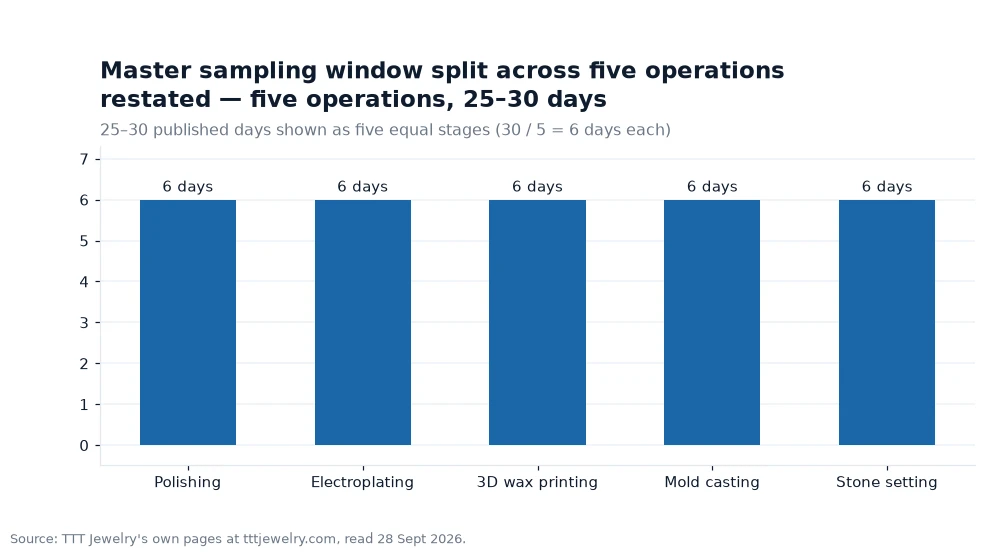
- Five bench stages occupy the sample window, at roughly six days per stage.
- Final QC inspects 100% of pieces, so the last step covers every unit rather than a statistical sample.
- A step is closed when its document is signed; an unsigned step is an open risk, not a completed one.
Why the sequence is fixed
Casting cannot begin before a mould exists, and a mould cannot be cut before a CAD file is approved. That physical dependency is why the six steps are written in order rather than as a menu. A buyer who asks to skip the sample and go straight to production is asking the factory to cut metal against an untested drawing.
The published flow from an ODM jewelry manufacturer also assigns an owner to each step. Inquiry and consultation belong to the buyer as much as to the seller: quantity, target material and price band decide whether a design is viable at 50 pieces in silver or 100 in brass. CAD and prototype belong to the modelling team. Sample and approval is a shared gate, with the factory making the piece and the buyer signing it off. Bulk production, inspection and delivery return to the factory floor.
That division matters when something goes wrong. If the sample is wrong because the brief was thin, the cost sits with the buyer. If it is wrong because the mould was cut off-spec, the cost sits with the factory. A documented flow makes the difference visible, which is the whole point of a quality system rather than a promise.
Steps one and two: what the brief must settle
An inquiry that arrives as a photo and a quantity will generate a quote with assumptions inside it. The consultation step exists to remove those assumptions. Base metal is the first fork: 925 sterling silver carries a 50-piece minimum per design, artisan eco-brass 100 pieces, stainless steel 100 or more. That single choice changes the mould, the plating method and the size of the order.
The second fork is finish. Silver and brass take anti-tarnish e-coating; stainless steel takes PVD vacuum plating. A brief that names the finish in terms a plater can act on — colour, sheen, coverage — saves a sample round. The third fork is packaging, which is easy to defer and costly to defer, because foil-stamped boxes, metallic logo tags and barcode labels have their own supply chain.
Buyers who compare sterling silver jewelry manufacturer options usually discover the same thing at this stage: the metal decision is really a decision about minimum quantity and finishing route, not only about price per gram.
Step three: the 48-hour CAD gate
The CAD file is the first artefact a buyer can genuinely review, and it arrives quickly: under 48 hours, or two working days. Review proportion before detail. A pendant that reads well at 30 mm can look thin at 12 mm, and a ring shank that looks heavy in a render can feel sharp between fingers. Read the file in three passes: silhouette, section and stone seat. Silhouette answers whether the shape holds at the intended size, section answers whether the metal is thick enough to cast and polish, and the seat answers whether the stone sits at the depth the setting needs.
The table below sets out what each step should leave behind. The document column is the one to check at the end of a project; where a step produced no document, there is no evidence that it happened in the way the quote described.
| Step | Document produced | Decision it closes |
|---|---|---|
| Inquiry | Written brief with quantity and target material | Whether the order fits a 50, 100 or 100+ piece minimum |
| Consultation and development | Material and finish specification | Which base metal and plating route the design takes |
| CAD and prototype | 3D file and render set, delivered under 48 hours | Geometry, scale and stone placement |
| Sample and approval | Physical master sample, 25–30 days | Fit, colour and hallmark position |
| Bulk production | Signed sample as the production reference, 21–28 days | The standard every unit is built to |
| Final QC and delivery | Inspection record covering 100% of pieces | Whether the consignment ships |
Steps four to six: from one piece to a run
The master sample is the contract in metal. Once signed, it becomes the reference for plating colour, stone height and surface finish across the run. Production then takes 21–28 days. During that period the sample should stay with the factory rather than on the buyer's desk, because the bench needs a physical comparison point, not a photograph on a phone.
Final QC inspects 100% of pieces. Read that literally: every unit passes a check, not a sample of the batch. For a 100-piece brass order that is 100 inspections; for a 50-piece silver order it is 50. The record from that step is the last document in the chain, and the one a buyer needs if a retail partner ever asks how a defect was caught before dispatch.
Worked example
Take a 100-piece brass order with five bench operations inside the sample window. The published window is 25–30 days, so the operations average 25 ÷ 5 = 5 days each at the fast end and 30 ÷ 5 = 6 days each at the slow end. That one-day difference per operation is where the range comes from; it is not a cushion bolted on at the end.
Add the CAD stage: 48 hours is 2 days, which is 8% of the shortest sample window and 6.7% of the longest. The full path from brief to dispatch is therefore 2 + 25 + 21 = 48 days at the fast end and 2 + 30 + 28 = 60 days at the slow end. A six-step flow does not remove those 48–60 days; it makes each day attributable to a step, which is what allows a buyer to challenge a delay with evidence instead of opinion.
Frequently asked questions
Which step carries the ISO 9001:2015 record?
The quality system covers production stages rather than a single step. In practice the inspection record from final QC is the document buyers ask for, because it covers 100% of pieces and closes the order.
Is the six-step flow the same for OEM and ODM work?
The steps are the same; the input differs. OEM starts with the buyer's CAD, while ODM starts with a concept that the factory develops into CAD before the sample gate.
How long does the sample step take?
The master sample takes 25–30 days following CAD approval. Five operations fill that span: casting, wax printing, stone setting, polishing and plating.
Why the paper trail earns its keep
Documentation separates a repeatable programme from a lucky first order. A buyer who keeps the brief, the CAD render, the signed sample record and the inspection sheet can reorder without rebuilding the specification from memory, and a second design is cheaper to brief because the material and finish decisions are already written down. Brands building a plated range alongside silver can see how the same six steps apply to custom brass jewelry before committing a drawing to a mould. The order of the steps does not change with the metal; only the tooling and the minimum quantity do.
Source note: figures come from the manufacturer's own website (tttjewelry.com), read 28 Sept 2026.[1]